It’s Monday morning. Coffee in hand. Laptop open. You’re ready to get moving.
Then your elbow clips the mug.
Time slows down just long enough for you to watch coffee spill across the keyboard and disappear into places coffee should never go.
The screen flickers. The keyboard stops responding. The laptop makes a noise laptops shouldn’t make.
Someone says it quietly, hopefully:
“Uh… I think I just messed something up.”
No hackers. No ransomware. No dramatic warning screens.
Just a completely normal moment that suddenly changes the day.
And that’s how a lot of real business disruption actually starts.
The Problem Isn’t the Mistake. It’s What Happens Next.
Most businesses picture downtime as something dramatic. Servers down. Systems dead. Everything grinding to a halt.
In reality, downtime is usually boring.
It’s usually:
A spilled drink on a laptop
A file that “definitely got saved” but now doesn’t exist
An update that finishes… badly
A computer that won’t boot for no obvious reason
The real damage doesn’t come from the mistake itself.
It comes from the stall that follows.
The waiting. The guessing. The ‘do we know how long this will take?’
Work doesn’t fully stop. It half-stops.
And half-working is often worse than not working at all.
The Hidden Cost of Waiting
Here’s what that stall usually looks like:
One person can’t work, so they wait. Two others try to help but aren’t sure what to do. Someone messages IT. Someone else starts working on something else “for now.”
Ten minutes turn into thirty. Thirty turns into an hour.
Multiply that by:
The number of people affected
The interruptions
The mental context switching
Even small delays add up fast.
Not in dramatic, headline-worthy ways, but in quiet, frustrating ways that drain momentum from the day.
Same Problem. Two Very Different Outcomes.
Let’s rewind the coffee spill.
Business A
No clear next step
No idea who handles recovery
“Maybe Dave knows?” (Dave’s on vacation)
People wait “just in case”
By lunch, half the day is gone.
Business B
The issue is reported immediately
The response is clear
Files are restored
The employee is back to work
Same coffee. Same mistake.
Completely different day.
The difference isn’t luck.
It’s recovery speed and clarity.
Why Well-Run Businesses Make Problems Boring
Here’s the shift most businesses miss:
The goal isn’t to prevent every small mistake. That’s impossible.
The goal is to make mistakes boring.
Boring means:
No scrambling
No guessing
No long pauses
No “who’s on this?” moments
When problems are boring, they don’t hijack the day. They don’t derail focus. They don’t ripple through the team.
They get handled. And everyone moves on.
This Is a Leadership Issue, Not a Tech Issue
When small problems cause big slowdowns, it’s rarely because of the tools themselves.
It’s because:
There’s no clear plan for “what happens next”
Responsibility is fuzzy
Recovery depends on the right person being available
The business hasn’t defined what “back to normal” actually means
What people feel isn’t the error or the outage.
It’s the uncertainty.
Well-run businesses remove that uncertainty.
A Simple Question Worth Asking
You don’t need a dramatic audit to start thinking differently about this.
Just ask one question:
If something small went wrong today, how long would it take for everyone to get back to work?
Not “eventually.” Not “if everything goes right.”
Actually, back to normal.
If the answer is unclear, that’s not a failure. It’s information.
And information is the first step toward smoother days, fewer stalls, and work that keeps moving even when something dumb inevitably happens.
The Takeaway
Most businesses don’t lose time to disasters.
They lose it to normal days that quietly go sideways.
The companies that stay productive aren’t the ones that avoid mistakes. They’re the ones that recover so quickly the mistake barely registers.
Your technology doesn’t need to be bulletproof. It needs to be recoverable.
Fast enough that problems become forgettable. Smooth enough that your team barely notices. Boring enough that work keeps moving.
That’s the goal.
Next Steps
Your business may already have a solid recovery plan in place — and if it does, that’s great.
But if you’re not completely sure how quickly your team would be back to work after a small, everyday issue, schedule a free 10-minute discovery call.
No pressure, no sales pitch — just a quick conversation to make sure small mistakes don’t turn into lost days.
Your accountant is buried. Your bookkeeper is scrambling. Deadlines are looming. Emails are flying faster than anyone can keep up.
Everyone’s head is down, just trying to get through the month.
This isn’t news to you.
But it isn’t news to hackers either.
Security researchers consistently see a significant spike in phishing attempts during tax season, with March bringing roughly a 28% increase in tax-themed scam emails compared to quieter months. These messages aren’t dramatic. They’re designed to blend in with everyday business requests, right when people are busiest.
That’s not coincidence. That’s timing.
Here’s what’s coming and four simple ways to make sure your business isn’t the easy target.
The Stressed Supply Chain
Here’s what most people miss:
Hackers aren’t just targeting accounting firms.
They’re targeting the chaos around them.
When tax season hits:
Clients rush to send sensitive documents
Staff members shortcut normal checks to keep up with volume
“Just send me the file” replaces usual caution
Verification gets skipped because everyone is slammed
The whole ecosystem speeds up.
And speed is where mistakes happen.
Hackers don’t go after calm, methodical businesses. They go after busy ones.
March is busy.
What These Attacks Actually Look Like
This isn’t a movie plot.
It’s an email that looks exactly like the others in your inbox.
A message from “your accountant” asking you to resend W-2s because something didn’t come through
A note from a vendor saying their bank information has changed and needs updating
A DocuSign request for a tax document that “needs your signature today”
An urgent email from “your CEO” who’s traveling and needs help immediately
None of these feel suspicious.
They feel like normal business in March.
That’s why they work.
Why Busy People Get Caught
This isn’t about being careless.
It’s about being human.
When inboxes are full and deadlines are tight, people don’t read carefully. They scan. They assume. They react.
Scammers know this.
Their messages are designed for people who are moving too fast to notice the one detail that’s off. They don’t need you to be reckless. They just need you to be busy.
And in March, almost everyone is.
Four Simple Ways to Not Be the Easy Target
The good news is you don’t need fancy tools or a security team to reduce your risk.
You just need a few intentional habits during busy months.
1. Verify payment changes by phone
If an email says a vendor’s banking details have changed, don’t reply to the message. Call a number you already trust and confirm it verbally. This single habit prevents some of the most expensive scams businesses face.
2. Slow down requests for sensitive information
Urgency should be a signal to pause, not to rush. If someone asks for W-2s, tax documents or financial files “right now,” take a moment to verify first. The real sender won’t mind a short delay. A scammer will.
3. Confirm “urgent” requests through a second channel
If an email claims something is urgent, verify it another way. A quick call, text or internal message can stop a bad decision before it starts. Real urgency can survive a two-minute check. Fake urgency can’t.
4. Give your team a five-minute heads-up
This week, remind your team that tax season is prime time for scams. Tell them it’s okay to slow down, double-check and ask questions when something feels off. That small permission shift can prevent a lot of unnecessary cleanup later.
The Takeaway
Tax season is stressful enough without adding “fell for a scam” to the list.
The attacks that show up this month aren’t especially clever. They’re just well-timed.
They rely on people being rushed. They rely on assumptions. They rely on everyone trying to power through March.
You don’t have to overhaul your systems to avoid becoming the easy target. You just have to slow down when it matters and verify when things feel urgent.
That’s often enough.
A Quick Busy-Season Sanity Check
Your business may already have good habits in place, and if it does, that’s great.
But if tax season tends to push everyone into reactive mode, or you’re not sure how your team handles urgent requests under pressure, it may be worth a quick sanity check with a free 10-minute discovery call.
No scare tactics. No pressure. Just a clear look at whether small habits could prevent big headaches this time of year.
If this doesn’t sound like your business, feel free to forward it to someone it does.
Green everywhere. Shamrocks in store windows. Leprechauns guarding pots of gold at the end of the rainbow.
Luck is fun.
It’s just not how well-run businesses actually operate.
Because no business owner would ever say:
“Our hiring strategy is whoever walks in the door.”
“Our sales plan is hope customers find us.”
“Our accounting approach is the numbers probably work out.”
That would be ridiculous.
And yet…
Somewhere Along the Way, Tech Gets a Pass
In a lot of small businesses, technology recovery quietly runs on a different standard.
Not intentionally. Not recklessly.
Just optimistically.
“We’ve never had an issue.” “It’s probably backed up somewhere.” “We’ll deal with it if something happens.”
That’s not a plan.
That’s a rabbit’s foot.
And unless there’s a leprechaun assigned to your IT systems, it’s a risky bet.
Why “We’ve Been Fine So Far” Isn’t a Strategy
Here’s the trap.
When nothing bad has happened, it feels like proof that nothing bad will happen.
It isn’t.
Every business that’s ever had a long, scrambling, how-did-this-happen day said “we’ve been fine” the morning before.
Luck isn’t a trend. It’s just risk you haven’t met yet.
And risk doesn’t care about your track record.
Prepared vs. “Probably Fine”
Most businesses don’t find out how prepared they are until they’re already stuck.
That’s when the questions start:
“Do we have a backup of this?”
“How recent is it?”
“Who actually handles this?”
“How long are we down?”
Prepared businesses already know the answers.
Lucky businesses find out in real time.
And real time is expensive.
The Double Standard Most Businesses Don’t Notice
Think about where you don’t tolerate uncertainty.
Hiring has a process. Sales has a pipeline. Finances have systems and controls. Customer service has standards.
Technology recovery?
A lot of businesses have hope.
Somewhere along the way, “what happens when something breaks” became the one business-critical function that feels okay to wing.
Not because you’re careless. Because it’s invisible until it isn’t.
And invisible risk is still risk.
This Isn’t About Fear. It’s About Professionalism.
Being prepared doesn’t mean expecting disaster.
It means:
Knowing what happens next
Removing guesswork
Reducing downtime from hours to minutes
Making interruptions boring instead of disruptive
The most resilient businesses aren’t lucky.
They’re deliberate.
They stopped betting on “probably fine.”
A Simple Reality Check
You don’t need a consultant to figure out where you stand.
Just ask yourself this:
If your accountant managed your books the way you manage tech recovery, would you be okay with that?
“We’re probably tracking expenses somewhere.” “I think someone reconciled things recently.” “We’ll figure it out when tax season hits.”
You wouldn’t accept that.
So why does technology get a pass?
The Takeaway
St. Patrick’s Day is a great excuse to wear green and hope for good fortune.
It’s a terrible model for running a business.
Well-run companies don’t rely on luck anywhere else. They don’t rely on it here either.
They hold their technology to the same standard they hold their people, their finances and their processes.
And when something goes wrong, because eventually it will, they’re ready to get back to work without drama.
Next Steps
Your business may already have solid systems in place, and if it does, that’s great.
But if parts of your technology still rely on “we’ll figure it out if it happens,” or if you know someone who’s been running a little too much on hope, it may be worth scheduling a 10-minute discovery call.
No scare tactics. No pressure. Just a quick conversation to close the gap between how you run everything else and how you handle this.
If this doesn’t sound like your business, feel free to forward it to someone it does.
College kids. Questionable decisions. Stories that start with “we thought it was a good idea at the time…”
But adults make plenty of spring break mistakes, too. They’re just quieter. And they usually involve technology.
You’re trying to be present with your family. But work doesn’t completely stop. So you rush. You multitask. You say, “I’ll just knock this out real quick.”
That’s where the problems start.
Here are the most common vacation tech mistakes — and how to not bring home a souvenir you didn’t ask for.
The “Free Wi-Fi Happy Hour”
The hotel has Wi-Fi. The coffee shop has Wi-Fi. The airport has Wi-Fi. You connect without a second thought — because you just need to send one email before the kids finish breakfast.
The risk: Fake networks with names like “HOTEL_GUEST_FREE” that are actually run by someone in the parking lot. Everything you do — logins, passwords, banking — captured by a stranger.
The fix: Use your phone’s hotspot for anything sensitive. If you must use public Wi-Fi, verify the exact network name at the front desk.
The “March Madness Streaming Situation”
The tournament is on. The hotel lobby is showing golf. So you Google “free March Madness stream” and click the first thing that looks vaguely legit.
Three pop-ups later, something downloads. You’re not sure what. But hey — the game is on!
The risk: Malware. Browser hijacking. Sites that look like ESPN but are very much not ESPN.
The fix: Stick to official apps. If the URL looks like it was typed by a cat, close the tab.
The “Sure Honey, You Can Use My Phone”
Your kid is bored. Your phone has games. You hand it over for 10 minutes of peace.
45 minutes later, they’ve downloaded three apps, accepted every permission and signed up for something called “RobuxFreeForever.”
The risk: Sketchy app permissions. Accounts tied to your email. In-app purchases you’ll discover next month.
The fix: Bring a dedicated tablet for kid entertainment — one that isn’t connected to your work or banking apps.
The “I’ll Just Log In Real Quick” Spiral
One email turns into the CRM. Then the accounting software. Then the client portal. Then Slack.
All on hotel Wi-Fi. All while your family waits.
The risk: Every login is a chance for someone on that network to grab credentials — especially when you’re rushing.
The fix: Use your hotspot for work stuff. Or ask yourself: can it actually wait two days?
The “I’m in Cabo!” Overshare
Beach photo. Posted. Location tagged. “Here until the 15th! 🌴”
The risk: You’ve just announced to the internet that your house is empty and you’re 2,000 miles away.
The fix: Post the vacation pics when you get home. The beach will still look great next week.
The “My Phone Is at 3%” Panic
There’s a USB port at the airport. Your phone is dying. You plug in.
The risk: Juice jacking — compromised charging stations that access your data while they power your phone.
The fix: Bring a portable charger. Use your own cable and your own power brick.
The “Vacation Password” Special
The resort Wi-Fi needs a login. You create one fast: “Beach2026!”
By the end of the trip, four new accounts all have the same password.
The risk: One breach exposes all of them.
The fix: Use a password manager. Let it generate random passwords for throwaway accounts.
The Takeaway
None of these mistakes happen because people are reckless. They happen because people are rushed, distracted and trying to get back to vacation mode.
That’s normal.
The goal isn’t perfection. It’s fewer “oh crap” moments when you get home.
Heading Out for Spring Break?
Your business may already have solid travel habits — and if it does, enjoy the beach.
But if you recognized yourself in a few of these (no judgment), a 10-minute discovery call might be what you need.
No pressure. No scare tactics. Just practical advice, so vacation stays vacation.
If this doesn’t sound like you, forward it to someone whose spring break tech habits could use a little help.
If you’re a business owner, you’ve had this exact thought:
“Why does everything take longer than it should?”
Not because your people are bad. Not because they don’t care. But because every process has extra steps baked in that nobody asked for. Those steps usually come from tech friction: tools that don’t connect, networks that drag, access chaos that makes everyone wait.
By Q1, that friction is the difference between “we’re moving” and “we’re stuck.” Let’s expose the three hidden bottlenecks slowing you down — and how to fix them without a giant overhaul.
Bottleneck #1: Your Apps Don’t Talk to Each Other
Translation: you’re running a “copy-paste business.”
Here’s what this looks like in real life:
Sales enters a customer in your CRM. Ops re-enters the same info into a project tool. Billing re-enters it again into accounting. Someone emails a spreadsheet to “make sure we’re aligned.”
Nobody wants to do this. They do it because the tools don’t share data, so humans become the integration layer.
That creates: duplicated work, dropped details, inconsistencies and delays that feel like “people being slow” but are really “systems being dumb.”
The hidden cost:
If one person spends 8 minutes a day retyping or reconciling data, you shrug. If 10 people do that every day:
8 minutes × 10 people = 80 minutes/day
80 minutes × 5 days = 400 minutes/week
400 minutes = 6.67 hours/week
6.67 hours × 4 weeks = 26.7 hours/month
That’s almost three full workdays every month lost to copy-paste busywork. Multiply
that by payroll and you’re burning money to keep your tools from speaking.
Bottleneck #2: Slow, Unstable Wi-Fi and Network Drag
Translation: death by a thousand spinning wheels.
This one is sneaky because it doesn’t feel like “a problem.” It feels like modern life.
Files take 12 seconds to open instead of 2. Cloud apps lag. Calls glitch. People restart things a couple times a day “just because.” Nobody throws a tantrum over 10 seconds here and 15 seconds there. But your business bleeds time in tiny cuts.
It also bleeds morale. Because nothing drains momentum like staring at a loading bar while a customer waits on the other end of the line.
Network drag turns good employees into tired employees. And tired employees look
unmotivated, even when they’re trying hard.
Bottleneck #3: Approval and Access Chaos
Translation: everyone is waiting on the one person with the password. This is where productivity goes to die quietly.
“Who has access to that folder?”
“Can someone approve this?”
“I need the login for ______.”
“Wait, only John can do that.”
“John’s out today.”
…dead stop.
Businesses normalize this because it feels like “just how things are.” But what it really is: a permissions system designed by accident.
When access is messy: work stalls, employees build workarounds, sensitive data gets shared in unsafe ways and you stay dependent on single points of failure.
That’s not efficient. That’s fragile.
The 10-Minute Bottleneck Diagnostic
Want to find your hidden bottleneck? Ask your team three questions:
“What’s one thing you do every day that feels like a waste of time?” Don’t prompt them. Don’t suggest answers. Just listen. You’ll hear the same things from multiple people.
“Where do you get stuck waiting for something or someone?” This reveals access problems, approval bottlenecks and slow handoffs.
“What’s one tool or system that makes your job harder than it needs to be?” This surfaces the technology that’s supposed to help but actually creates friction.
Ten minutes. Three questions. You’ll have a list of bottlenecks by the end of the week. The hard part isn’t finding them. It’s fixing them.
Fixing the Bottlenecks
Once you see the friction, you can remove it.
Apps that don’t talk? Integrate them. Most modern business tools can connect — sometimes natively, sometimes through automation platforms. The right setup means data flows automatically instead of manually.
Slow network and Wi-Fi? Audit it. Upgrade it. Optimize it. Sometimes it’s old equipment. Sometimes it’s bad configuration. Sometimes it’s just too many devices on too little bandwidth. There’s always a reason — and usually a fix.
Access chaos? Build a real permissions structure. Document who has access to what. Set up proper onboarding so new people get access on day one. Use a password manager so nobody’s sharing credentials via text.
None of this is glamorous. It’s infrastructure. Plumbing. The boring stuff that makes everything else work better. But boring stuff compounds. Fix one bottleneck and the whole team moves faster. Fix two and you start wondering why you waited so long.
How an MSP Removes the Drag
Most business owners know something is slowing them down. They just don’t have time to diagnose it, research solutions and implement fixes while also running the business.
A good MSP helps by:
Integrating tools so data flows automatically instead of manually
Stabilizing your network so cloud tools feel instant
Setting clean access rules so people aren’t stuck waiting
Automating handoffs so work moves without chasing approvals
Building systems that match how your industry operates
In other words: we make productivity the default. Not because your people changed. Because the environment stopped working against them.
Is Friction Slowing Your Q1?
If your systems run smooth, your team has the access they need and workflows without unnecessary delays — great. You’ve already done the hard work.
If you suspect there’s hidden friction but haven’t had time to find it — that’s worth fixing before Q2.
And if you know a business owner whose team seems busy but results aren’t matching the effort, send them this article. The bottleneck usually isn’t the people.
Want help finding and fixing the hidden drag on your business?
By February, the “new year glow” wears off and reality kicks in. The inbox is still overflowing, meetings still multiply like gremlins and you’re still doing too much with too little time. Meanwhile, AI is everywhere.
Every app you open is screaming some version of: “Add AI!” “Automate with AI!” “Use AI or die!” And you’re sitting there thinking: “Cool. But… where does this actually help my business and how do I make sure it doesn’t blow up in my face?”
That’s the right question.
Because AI right now is basically the new intern everyone hired without training. Interns can be amazing. They can also accidentally email the wrong thing to the wrong person if nobody sets rules.
Same deal with AI.
Done right, it saves you hours and makes your business faster. Done wrong, it leaks data, confuses your team and creates expensive “oops” moments. So, let’s do this the sane way.
3 AI Uses That Actually Save Time in a Small Business
1) Inbox triage + first-draft replies
If your email inbox is a landfill, AI can help you sort the trash.
What AI is good at: scanning long email threads, pulling out what matters, drafting a solid first response, flagging things needing your attention.
What it’s not good at: knowing your customer context, understanding nuance, sending the final word.
So, the workflow is simple: AI drafts. Human approves. You cut the typing time without handing the steering wheel to a robot.
Example: A 12-person professional services firm used AI to draft replies to common client questions (status updates, scheduling, FAQs). The owner stopped writing everything from scratch and saved about 30-45 minutes a day. That’s 10-15 hours a month back. Not flashy. Just useful.
2) Meeting notes → action lists
Meetings are a tax on productivity. And the bigger problem isn’t the meeting — it’s the follow-through.
AI note tools can: summarize the conversation, pull out decisions, list action items, assign owners, create a clean recap.
The payoff: no more “wait, what did we decide?” Fewer dropped balls. Faster turnaround after meetings. Less time rewriting notes nobody reads anyway.
If your team does recurring client meetings, project check-ins or weekly ops calls, this is easy time savings.
3) Simple reporting and forecasting
Most business owners don’t lack data. They lack time to interpret it.
AI can help you: summarize weekly sales trends, highlight anomalies, predict inventory needs, surface patterns in churn or support tickets, turn raw numbers into plain English.
Not as a crystal ball. As a sorting machine.
AI doesn’t replace your judgment. It gives you a clearer dashboard so you can use your judgment without digging through spreadsheets for an hour.
The Guardrails: How to Use AI Without Doing Something Dumb
This is where most small businesses get burned. They start using AI casually, like it’s a search engine and accidentally feed it something sensitive.
Here are the simple rules:
Rule #1: Never paste sensitive data into public AI tools. Customer personal info. Payroll or HR data. Medical or legal records. Passwords or access keys. Internal financials. Anything you’d be uncomfortable seeing on the front page of the internet. If it identifies a person or a company, it doesn’t get pasted.
Rule #2: Control who can use what. Right now, “shadow AI” is exploding in small businesses. Employees sign up for random AI apps with corporate data because they want to be efficient. Good intent, bad outcome. You need: a short approved tools list, a policy on what data can be used and permissions so sensitive roles (HR, finance, legal) don’t improvise.
Rule #3: AI drafts, humans decide. AI is great at first passes. Humans own the final outcome. This matters because AI makes things up. Confidently. Fluently. Wrongly. If AI writes something that goes out under your brand, somebody approves it first. No exceptions.
Rule #4: Assume everything you type is being stored. Because it probably is. Public AI tools may store inputs or use them for training. Even if it’s not being used today, it’s sitting on someone else’s servers. Act accordingly.
Rule #5: When in doubt, ask. If someone’s not sure whether something is okay to paste, the answer is “don’t” until they’ve checked. Make it easy to ask. Make it safe to ask.
Five rules. Simple enough to fit on an index card. Strong enough to prevent most AI-related disasters.
What This Looks Like in a Real Business
Here’s the simple version of “AI done right”:
A small business chooses 1-2 boring processes where time is being wasted. They add AI there, with rules. They measure the impact. Then expand slowly.
Not a massive “AI transformation.” A practical upgrade.
The businesses pulling ahead aren’t the ones with the fanciest AI strategy. They’re the ones who set guardrails early and started experimenting safely.
How an MSP Keeps AI Helpful Instead of Risky
This is where most owners quietly want help.
You don’t want to: research fifty AI tools, guess which one is safe, write policies from scratch, wonder if your data is leaking or find out six months later that someone’s been uploading client files into a free AI app.
A good MSP helps by: • Recommending tools that fit your industry and compliance needs • Locking down access and permissions • Setting clear AI usage rules people can actually follow • Integrating AI into your workflow instead of adding more clutter • Monitoring for shadow AI and risky data sharing
So, AI actually saves time … without creating new headaches.
Where Does Your Business Stand?
If you’ve already got an AI policy and your team knows what’s okay to share (and what isn’t), great. You’re ahead of most small businesses.
If you’re not sure what your team is pasting into AI tools right now — that’s worth finding out. Before something sensitive ends up somewhere it shouldn’t.
And if you know a business owner drowning in AI hype and worried about doing it wrong, send them this article. It might save them a very expensive lesson.
Want help setting up AI guardrails that actually work?
It’s February. Tax season is ramping up. Your accountant is getting busier. Your bookkeeper is pulling documents. Everyone’s thinking about W-2s, 1099s and deadlines.
Here’s the part nobody puts on the calendar: the first real tax-season headache usually isn’t a form. It’s a scam.
And there’s one that shows up before April even gets close because it’s easy, believable and aimed straight at small businesses. You might already have it sitting in someone’s inbox.
The W-2 Scam: How It Works
Here’s the setup:
Someone in your company (usually whoever handles payroll or HR) gets an email that looks like it’s from the CEO, owner or a senior exec.
The message is short and urgent:
“Hey, I need copies of all employee W-2s for a meeting with the accountant. Can you send them over ASAP? I’m slammed today.”
It looks normal. The tone sounds right. Tax season is busy, so the urgency feels natural. The request seems reasonable.
So, your employee sends the W-2s.
Except the email wasn’t from the CEO. It was from a criminal using a spoofed address or a look-alike domain.
And now that criminal has every employee’s:
• Full legal name • Social Security number • Home address • Salary information
Everything needed for identity theft. Everything needed to file fraudulent tax returns before your employees do.
What Happens Next
Here’s how victims usually find out:
Your employee files their tax return. It gets rejected: “Return already filed for this Social Security number.”
Someone already filed in their name. They already claimed their refund. Already got the money.
Now your employee is dealing with the IRS, credit monitoring, identity theft protection and months of paperwork because of a document they didn’t even know they sent.
Multiply that by your entire payroll. Now imagine explaining to your team that their personal information was compromised because someone fell for a fake email.
That’s not just a security problem. That’s a trust problem. An HR nightmare. A potential lawsuit. A reputation hit.
Why This Scam Works So Well
This isn’t a Nigerian prince email. It doesn’t look fake at first glance.
It works because:
The timing is perfect. W-2 requests are expected in February. Nobody questions why someone would ask for them now.
The request is reasonable. It’s not “wire $50,000” or “buy gift cards.” It’s something that actually does get shared during tax season.
The urgency feels normal. “I’m slammed today, can you send this quick?” doesn’t raise red flags in a busy office.
The sender looks legitimate. Criminals research targets. They know the CEO’s name. Sometimes they know your accountant’s name. They make it look real because they did their homework.
Employees want to be helpful. Especially to the boss. Urgency overrides verification.
How to Protect Your Business (Before This Lands)
The good news: this scam is preventable. And it takes policy + culture more than fancy tech.
Make a “no W-2s via email” rule. Period. No exceptions. W-2s and other sensitive payroll documents do not leave your building through email attachments. If someone asks for them via email, the answer is “no,” even if it looks like the CEO.
Verify any sensitive request in a second channel. Phone call. In person. Chat. Anything other than replying to the email. Use a number you already have, not one in the message. It takes 30 seconds. Can save months of cleanup.
Do a 10-minute tax-scam huddle now. Not later. Not “when we get closer.” Tell your payroll/HR people: “These are about to spike. This is what they look like. This is what we do.” Awareness is cheap insurance.
Lock down payroll and HR systems. Multi-factor authentication (MFA) on anything that touches employee data. If someone’s credentials get phished, MFA is the last door they’ll slam into.
Make verification a culture, not a burden. The employee who calls to double-check a request from the CEO should be praised, not made to feel paranoid. When questioning is rewarded, scams have nowhere to hide.
That’s it. Five rules. Simple enough to implement this week. Strong enough to stop the first wave.
The Bigger Picture
The W-2 scam is just the opening act.
Between now and April, expect a flood of tax-themed attacks:
• Fake IRS notices demanding immediate payment • Phishing emails disguised as tax software updates • Spoofed messages from “your accountant” with malicious links • Fraudulent invoices timed to look like tax expenses
Criminals love tax season because everyone’s distracted, everyone’s moving fast and financial requests don’t seem unusual.
Businesses that get through tax season clean aren’t luckier. They’re prepared.
They have policies. They have training. They have systems that catch suspicious requests before they become disasters.
Is Your Business Ready?
If you’ve already got policies in place and your team knows what to look for, great. You’re ahead of most small businesses.
If not, now is the time. Not after the first scam hits.
If this sounds like your business, book a 10-minute discovery call with us and we’ll review:
Payroll/HR access and MFA
Your W-2 verification rules
Email protections that catch spoofing
The one policy tweak most businesses miss
If it doesn’t sound like you, awesome. But you probably know a business owner it does sound like. Forward them this article. It might save them a very expensive headache.
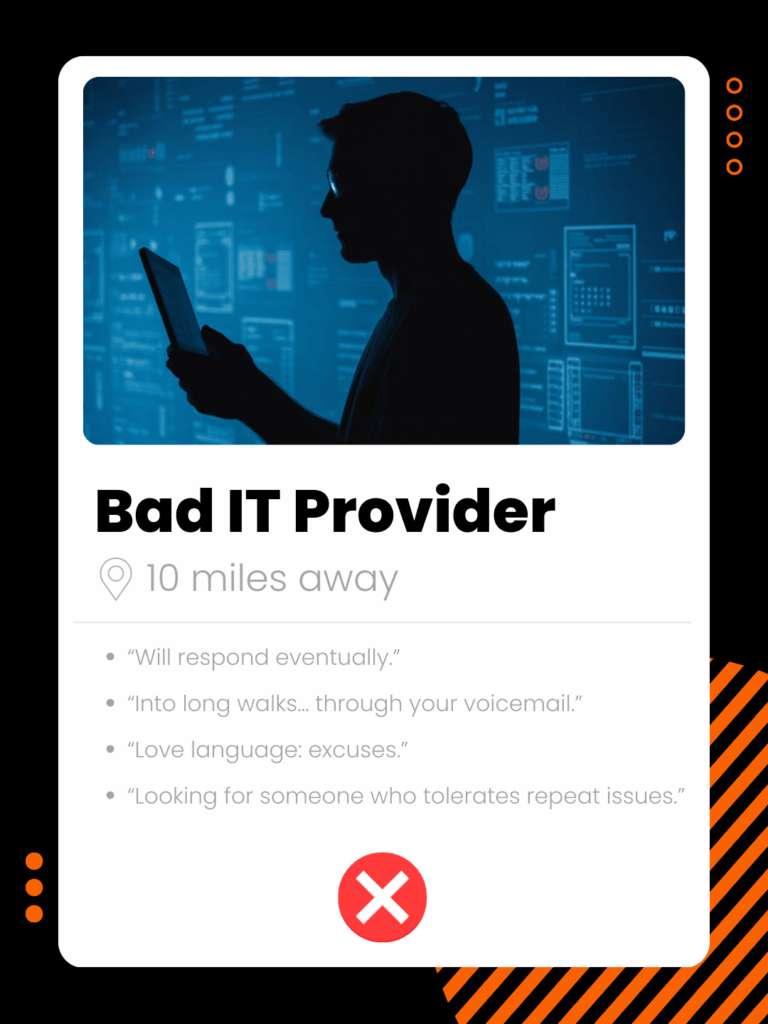
Ever Had an IT Relationship That Felt Like a Bad Date?
It’s February. Love is in the air. People are buying chocolate, making dinner reservations, pretending they like rom-coms again. So, let’s talk about relationships.
Have you ever had a tech relationship that felt like a bad date? The kind where you call for help and get silence. Or the “fix” works for a day and then the problem comes right back.
If you’ve ever lived through that, you know how exhausting it is. And if you haven’t, congrats. You’ve avoided a very common small-business headache.
Because a lot of business owners are still stuck in the IT version of a bad relationship:
They keep hoping it’ll get better.
They keep making excuses.
They keep saying “well, they’re cheap,” like that makes the drama worth it.
They keep calling … even though they don’t trust the provider anymore.
And like most bad dates, it didn’t start out this way.
The Honeymoon Phase
At first, the IT person was responsive. Helpful. Fast. They set things up, fixed a few issues and the business thought, “Great. This is handled.”
Then the business grew. The tech stack got messier. Threats got smarter. The team got busier. And the relationship changed.
The same problems started popping up again. Replies slowed down. You got that familiar line: “We’ll take a look when we can.”
So owners did what people do in every bad relationship: they adapted their business around someone else’s bad behavior.
That’s not partnership. That’s survival.
The Voicemail Black Hole
You call. You leave a message. Maybe you email. Then you wait. Hours. Sometimes days.
Meanwhile, your employee is stuck, your team can’t work, deadlines slip, customers get impatient. You’re paying employees who can’t do their jobs because IT “support” is missing in action.
That’s not support. That’s a bad date who says “I’m on my way” and then disappears.
Healthy tech relationships don’t leave you hanging. Problems get acknowledged fast, triaged fast and fixed fast. Better yet — many of them never happen because someone is watching your systems before they melt down.
The Arrogance
This one is the worst.
They finally show up, fix the problem and act like you should be grateful they squeezed you into their royal schedule.
You get the vibe of:
“You wouldn’t understand.”
“This is just how it is.”
“You should’ve called sooner.”
“Try not to do that again.”
It’s like dating someone who causes drama, then lectures you for having feelings about it.
A good IT partner doesn’t make you feel stupid for needing help. They make you feel relieved that you’ve got someone in your corner.
Because technology isn’t supposed to be a test of character. It’s supposed to be boringly reliable.
The Workaround Trap
This is where you know things are truly bad.
Because they’re hard to reach, your team stops calling. They start solving things themselves. They email files instead of using the system. They save stuff on desktops. They share passwords in text messages. They buy random tools just to get through the day.
Not because they want to break rules. Because they want to do their jobs without waiting two days for help.
You see it in little stuff at first: like the office where the Wi-Fi drops every afternoon at the same time, so everyone silently schedules meetings around the dead zone.
That’s not tech “working.” That’s your business learning to tiptoe around broken systems.
And workarounds create quiet disasters: security holes, compliance risks, duplicated tools, inconsistent processes, tribal knowledge that vanishes when someone quits.
Workarounds are what businesses build when they don’t trust their tech relationship anymore.
Why Tech Relationships Go Bad
Most small-business tech relationships fail for the same reason most real relationships fail: no one is maintaining the relationship.
Tech often runs on a reactive model: something breaks, you call, they patch it, everyone ignores it again, repeat. That’s like only talking to your spouse during fights. You’re technically communicating … but you’re not building anything stable.
Meanwhile, business keeps changing: more staff, more data, more apps, more customer expectations, more compliance pressure, more attacks aimed at companies exactly like yours.
So the IT relationship that worked with five people and one shared drive doesn’t survive with 15 people, remote, running cloud apps and being targeted by smarter criminals.
A good IT partner doesn’t just fix problems. They prevent problems. They monitor, patch and maintain quietly in the background so issues don’t sneak up on you during payroll, tax prep or your biggest client deadline of the quarter.
That’s the difference between firefighting (cheap, chaotic, exhausting) and fire prevention (predictable, stable, scalable). One feels like a bad date you keep rescuing. The other feels like a grown-up partnership.
What a Healthy Tech Relationship Feels Like
A good tech relationship isn’t exciting. It doesn’t create drama. It feels calm.
It looks like: your systems behave during deadlines, your team doesn’t dread updates, files live in one clear place, support responds fast and fixes it right, your tools fit how your industry actually runs, your data is secure and compliant, growth doesn’t break everything.
Here’s the real sign you’re in a good tech relationship: you stop thinking about IT most days. Because it just works. Not trendy. Not magical. Reliable.
The Big Question
If your IT provider was a person you were dating, would you keep seeing them? Or would your friends say, “Seriously? You’re still calling that guy?”
If you’ve normalized bad tech behavior, you’re paying twice: in dollars and in stress. And neither one is necessary.
If you’re already in a solid place with your tech, awesome. This is for the business owners who aren’t … and there are a lot of them.
Know Someone Stuck With “Bad Date” Tech?
If this sounds like your business, book a 10-minute discovery call and we’ll show you how to get rid of the tech relationship drama fast.
If it doesn’t sound like you, great. But odds are you know someone it does sound like. Forward this to them. We’ll help.
As organizations finalize their growth strategies for the new year, organized cybercrime syndicates are finalizing theirs. Their business model is simple: exploit the gaps left by busy Small and Midsize Businesses (SMBs).
This piece outlines the Top 4 Cybercriminal Objectives for 2026 and provides the definitive counter-strategy for effective SMB risk mitigation.
I. The Adversary’s Focus: Mastering Social Engineering and AI
Cybercriminals are shifting resources to target human vulnerability using sophisticated technology.
Objective 1: Achieve Zero-Detection Phishing with AI
The days of obvious scam emails are over. Criminals now utilize advanced Generative AI to craft hyper-realistic, contextualized messages that bypass both human and technical scrutiny. These attacks succeed by leveraging organizational language and referencing real client or vendor relationships to establish trust.
Strategic Solution: Implement Multi-Layered Email Security and Policy Enforcement. You must deploy advanced email security tools integrated with DMARC and Impersonation Detection. More critically, implement a mandatory, documented Verification Policy. Any financial or credential request must be confirmed through a separate, trusted channel (phone call to a known number). This is essential cybersecurity best practice.
Objective 2: Perfecting Business Email Compromise (BEC) via Voice and Identity Cloning
Impersonation attacks targeting financial personnel are becoming nearly undetectable.
Attackers launch sophisticated CEO Fraud scams via email or even text, requesting urgent, unverified payments. Crucially, deepfake voice cloning is rapidly moving from science fiction to common attack methodology. Voices scraped from YouTube or even voicemail greetings are used to call finance staff, lending terrifying authenticity to fraudulent wire transfer requests.
Strategic Solution: Mandate Multi-Factor Authentication (MFA) and Dual-Control Protocols.MFA must be enabled on all critical accounts (especially finance, admin, and email). For all outgoing payments above a defined threshold, a non-negotiable Dual-Control Policy must be in place—requiring approval via a separate confirmation channel before any funds are released.
II. Strategic Targets: Why SMBs are the Primary Focus
The criminal shift away from hardened enterprises and toward SMBs is a calculated economic strategy.
Objective 3: High-Volume, Low-Resistance Attacks Against Small Businesses
Cybercrime has optimized for volume and reduced resistance. It is easier and less risky to execute hundreds of smaller, highly successful attacks against unprepared SMBs than to attempt one major breach against a Fortune 500 company protected by a $50M security budget.
Criminals specifically rely on the SMB belief: “We are too small to be a target.”
Strategic Solution: Achieve Foundational Cyber Hygiene. Your goal is to be harder to breach than the business next door. Key SMB risk mitigation measures include MFA deployment, continuous vulnerability patching, consistent security awareness training, and a guaranteed, tested disaster recovery plan. These measures compel attackers to seek easier targets.
Objective 4: Exploiting HR and New Employee Onboarding Vulnerabilities
The high turnover and holiday-related distractions of Q1 make new hires and accounting staff prime targets. New employees lack the internal cultural context to question authority and are easily manipulated into initiating fraudulent wire transfers or releasing sensitive data (like employee W-2s during tax season phishing campaigns).
Strategic Solution: Integrate Security Awareness from Day One. Comprehensive security awareness training must be mandatory during employee onboarding. Establish clear, written policies: “W-2 data is never transmitted via email” and “Any urgent financial request is always verified.” Conduct simulated phishing exercises to build a culture where caution is praised.
III. The Core Strategy: Proactive Risk Management is Non-Negotiable
Businesses face two fundamentally different financial models when dealing with cyber threats: Reactive Recovery (crippling cost) versus Proactive Prevention (predictable investment).
Reactive Recovery: This path involves paying ransom, emergency forensic services, customer notification, and system rebuilding. The cost is high, often tens or hundreds of thousands of dollars, coupled with weeks or months of crippling downtime, reputational damage, and potential regulatory fines. This is a business extinction event.
Proactive Prevention: This path involves utilizing an MSSP (Managed Security Service Provider) to implement necessary controls. This is a predictable, fixed monthly operational expense (OpEx). The MSSP ensures 24/7 threat monitoring, continuous patching, and guaranteed disaster recovery capabilities. The outcome is continuous operation and risk avoidance.
Your IT strategy must prioritize fire prevention over firefighting.
Take Control: Schedule Your Strategic Cyber Risk Assessment
The time for assumption is over. You need a clear, external view of your organizational vulnerabilities.
A specialized Managed IT Security Partner will move you off the adversary’s target list by:
Providing expert guidance on regulatory compliance (e.g., HIPAA, PCI).
Implementing and managing centralized patch management to close vulnerabilities.
Guaranteeing the integrity and testability of your business continuity and disaster recovery (BCDR) plan.
Book Your 2026 Strategic Cybersecurity Review
Invest 15 minutes to receive a preliminary view of your current exposure and the definitive roadmap required to achieve robust, enterprise-grade data security this year.
No obligation. No jargon. Just an expert assessment of your SMB security posture.
Millions start January by eliminating a negative habit for better health and focus.
Your business deserves the same clarity and security. Instead of cocktails, your organization is likely consuming inefficient and risky tech habits—the ones everyone knows are bad but persists with because “it’s always been fine” or “we’re too busy.”
Until it isn’t fine.
This month, commit to a Digital Dry January. Here are six critical habits that increase your IT security risks and drag down productivity, along with the structural solution to eliminate them forever.
The 6 Critical Bad Tech Habits to Quit Now
Habit #1: Clicking “Remind Me Later” on Security Updates
That simple click is a greater threat to small business IT security than sophisticated hackers. These updates are crucial, often patching severe vulnerabilities that are already known and actively exploited by cybercriminals. Delaying turns days into weeks, leaving your systems wide open.
Quit It: Stop relying on individual employee diligence. Managed IT services ensure updates (patches, operating systems, applications) are deployed automatically and centrally, typically outside business hours. This eliminates the “Remind Me Later” button and immediately reduces your cyber risk.
Habit #2: Reusing the Same Master Password Everywhere
You have a go-to password. It’s memorable, strong, and you use it for email, banking, and every online tool. The issue? Data breaches occur constantly. When one minor, unsecure platform is breached, your email-password pair is sold to attackers. This process, called “credential stuffing,” allows hackers to test your master key across all your high-value accounts.
Quit It: Implement a corporate password manager (like Bitwarden, 1Password, or LastPass). Your team only needs to remember one master password, while the system generates and stores unique, complex credentials for every other site. This is non-negotiable fundamental security.
Habit #3: Sharing Logins via Insecure Channels (Email/Text)
“Can you send me the Wi-Fi code?” “What’s the admin login?” When credentials are sent via Slack, email, or text, they create a permanent, searchable record. If anyone’s account is compromised, the attacker can search their history for “password” and harvest all your access codes.
Quit It: Leverage the secure sharing features built into your password management solution. The recipient gets temporary access without ever seeing the actual password. The access can be instantly revoked, leaving zero permanent digital footprint.
Habit #4: Granting Blanket Admin Rights for Convenience
Because it was easier than setting up specific user permissions, half your team now holds full admin privileges. Admin access gives users (and, more critically, any attacker who compromises their account) the power to install malware, disable security software, and cause maximum damage. Ransomware thrives on elevated privileges.
Quit It: Enforce the Principle of Least Privilege (PoLP). Employees receive only the access required for their jobs, and nothing more. While this takes initial setup time, it dramatically limits the scope of damage from internal errors or external breaches.
Habit #5: The “Temporary” Workaround That Became Permanent Policy
A system broke years ago, and a clunky manual workaround was implemented—”just until we can fix it properly.” That stopgap measure is now a deeply embedded, fragile process that requires tribal knowledge and wastes countless hours. Workarounds are a single point of failure that multiplies lost employee productivity.
Quit It: Make a formal list of all internal workarounds. Do not attempt to fix them internally. Instead, partner with us to review your operations. We can replace these fragile, time-wasting processes with stable, modern solutions that run efficiently and automatically.
Habit #6: Relying on the Critical Spreadsheet That Runs Everything
You know the one: The massive, multi-tab Excel file with complex, undocumented formulas that only one retired employee fully understood. This spreadsheet is a massive single point of failure. It lacks proper audit trails, cannot scale, and is rarely backed up effectively. You are operating a critical business process on digital duct tape.
Quit It: Transition mission-critical data and processes to dedicated, scalable business systems. Use CRM for customer tracking, ERP for inventory, and specialized accounting software. These tools come standard with features your spreadsheet lacks: security, backups, and robust audit logs.
Why Bad Habits Are So Hard to Break (And What Actually Works)
You are not uninformed; you are overwhelmingly busy. Bad tech habits persist because:
The Consequences Are Delayed: Using a weak password works perfectly until the day your bank account is drained. The disaster is instant and total.
The “Right Way” Seems Slower: Setting up a password manager takes an hour. Typing the old password takes three seconds. Short-term convenience always wins without a structural mandate.
Normalization: When everyone on the team shares credentials via email, the risky behavior feels normal, not dangerous.
Willpower does not work for Dry January, and it will not work for fixing your IT.
The only effective solution is changing your environment so the secure, correct behavior is the easiest behavior:
Automation: Updates are pushed automatically.
Systemic Control: Password managers are enforced company-wide.
Centralized Management: Permissions are managed by experts (PoLP).
This is what a true Managed Services Provider delivers. We don’t just lecture you about habits; we restructure your systems so the good habit becomes the default, making the bad habit impossible.
Ready to Eliminate Your Hidden IT Security Risks?
Make the single best decision this month: stop relying on personal willpower and implement a secure structure.
Book Your 15-Minute Business Security Audit
In just 15 minutes, we will review your current risks and pinpoint the quickest, most effective steps to eliminate these unnecessary vulnerabilities and save your team time.
No judgment. No complex jargon. Just a clear roadmap to a safer, faster, and more profitable 2026.